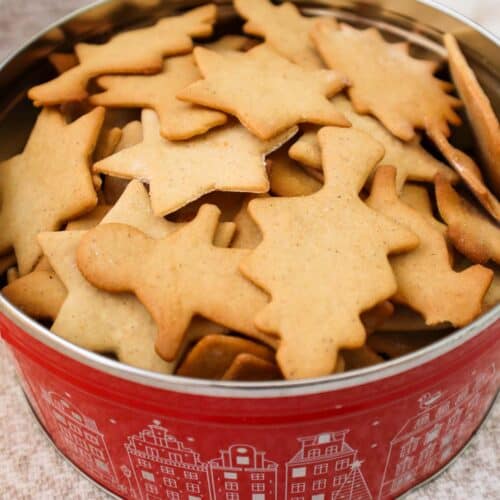
Piparkūkas (Latvian Gingerbread Cookies)
Thin, crisp Latvian gingerbread cookies made the old-fashioned way, with malt extract, dark brown sugar, honey, lard and an eight-spice blend. The dough rests overnight, or up to three days for the fullest flavor, then bakes in minutes.
Equipment
- 1 Dutch Oven or large heavy-based pan. The thick base heats gently and makes it easier to stop the syrup before it boils.
- 1 Kitchen Scale to measure the flour, malt and sugar.
- 1 Sturdy wooden spoon for beating the flour into the hot syrup
- 1 Sieve for sifting flour and spices
- 1 Kitchen thermometer (Optional) to check temperature of dough.
- Parchment paper to wrap the dough
- Plastic wrap to wrap the dough (first in parchment paper)
- Small cookie cutters about 2 to 2½ in (5 to 6 cm)
- 1 Pastry brush for egg wash
- Cookie tins or airtight container, for storing
Ingredients
- 2 cups all-purpose (plain) flour for the spices
- 2 tsp ground cinnamon
- ¾ tsp ground ginger optional
- 1½ tsp ground cardamom
- ½ tsp ground coriander
- ¾ tsp ground cloves
- ¾ tsp ground allspice
- ½ tsp ground nutmeg
- ¼ tsp freshly ground black pepper
- 2/3 cup unhopped liquid malt extract light or amber
- 3 tbsp honey
- 9 tbsp dark brown sugar packed (or light brown or superfine sugar)
- 1 tbsp water
- 5½ tbsp lard
- 5 tbsp butter
- ½ tsp baking soda
- 1 pinch sea salt
- 1 tsp water
- 1 egg + 1 egg yolk lightly beaten
- 2 cups all-purpose (plain) flour added after the egg
- 1/2 cup all-purpose (plain) flour for rolling out the dough
- 1 egg beaten, for glazing (optional)
For the icing (optional)
- 1 egg white
- 2 cups powdered sugar sifted
- ½ tsp lemon juice
Instructions
- Mix the spices into the first 2 cups (250 grams) of flour.
- In a large, heavy-based pan or Dutch oven, stir the malt extract, honey, dark brown sugar and 1 tbsp water over low heat for 3 to 5 minutes, or a little longer, until no grains remain. Do not let it bubble.
- Add the lard and butter and stir until melted.
- Raise the heat slightly and stir. Remove from the heat as soon as small bubbles appear at the edge. Do not let it boil.
- Immediately beat in the spiced flour with a wooden spoon until the dough leaves the sides of the pan.
- Cool to 95 to 105°F (35 to 40°C).
- Dissolve the baking soda and salt in 1 tsp water. Beat in the egg, yolk and soda mixture.
- Stir in the remaining 2 cups (250 grams) of flour until even. The dough will be soft and sticky. Do not add extra flour.
- Shape into flat disks, wrap, cool for up to 1 hour, then refrigerate overnight, or up to 3 days for the fullest flavor.
- Take the dough out of the fridge 30 minutes before rolling. Roll small pieces to 1/16 in (1 to 2 mm) thick on a lightly floured surface.
- Cut out shapes, place on baking sheets lined with parchment paper, and brush with beaten egg if you like.
- Bake at 390°F (200°C), 350°F (180°C) convection or gas mark 6 for about 5 to 6 minutes, until the edges just begin to darken.
- Cool on the baking sheet, then store in an airtight container.
To Ice (Optional)
- Whisk the egg white until foamy, then gradually beat in the powdered sugar and lemon juice until thick, white and glossy, like thick sour cream.
- Pipe or brush onto completely cooled cookies, and let dry for about 2 hours, until hard.
Notes
Yield: This dough weighs about 2½ lb (1.1 kilos) and makes about 200 thin cookies (150-250 depending on your cookie cutters), 1/16 in (1 to 2 mm) thick, with a 2 to 2½ in (5 to 6 cm) cutter. Each cookie is made with about 4 - 7 grams of dough.
- Ginger: Optional. Use up to 1 tsp, or leave it out. There is some debate about whether Latvian gingerbread cookies should have ginger in them (some recipes don't), but my grandmother's did.
- Orange zest: Add the finely grated zest of ½ orange with the spices. Orange zest is sometimes included in older recipes.
- Dark brown sugar: You can substitute ½ cup + 2 tbsp (120 g) superfine or granulated sugar, or ½ cup + 1 tbsp, packed (120 g) light brown sugar.
- Golden syrup and molasses version: Replace the malt extract with ⅓ cup + 1 tbsp (130 g) golden syrup and 3½ tbsp (70 g) molasses, and cut back the sugar to a scant ½ cup (100 g) light or dark brown sugar.
- No lard: Use about 2/3 cup (155 g) butter in total.
- If the cookies puff: Use ¼ tsp baking soda next time.
- Storage: Dough keeps up to 3 days in the fridge or 3 months frozen (thaw overnight in the fridge). Baked cookies keep several weeks in an airtight container, so they make lovely gifts.
- Egg-free icing: Stir 1 cup (120 g) powdered sugar with 1½ tbsp milk or lemon juice. It doesn't dry as hard.
- Icing safety: The glaze uses raw egg white. For young children, anyone pregnant or older adults, use pasteurized egg white or meringue powder. Or try the egg-free icing above.
Nutrition
Serving: 1cookieCalories: 23kcalCarbohydrates: 4gProtein: 0.3gFat: 1gSaturated Fat: 0.3gPolyunsaturated Fat: 0.1gMonounsaturated Fat: 0.2gTrans Fat: 0.01gCholesterol: 2mgSodium: 6mgPotassium: 5mgFiber: 0.1gSugar: 2gVitamin A: 10IUVitamin C: 0.01mgCalcium: 2mgIron: 0.1mg
Tried this recipe?Let us know how it was!